I still remember the day I walked into a co-working space in my city, introduced myself as a “startup founder,” and got a politely confused look from the guy sitting across from me. He asked, “So you’re raising money? Who’s your lead investor?” I paused. I had no investor. I was running a small consulting firm with three clients and a part-time employee. That was the moment I realized I had been using the wrong word for what I was building and honestly, it mattered more than I thought it would.
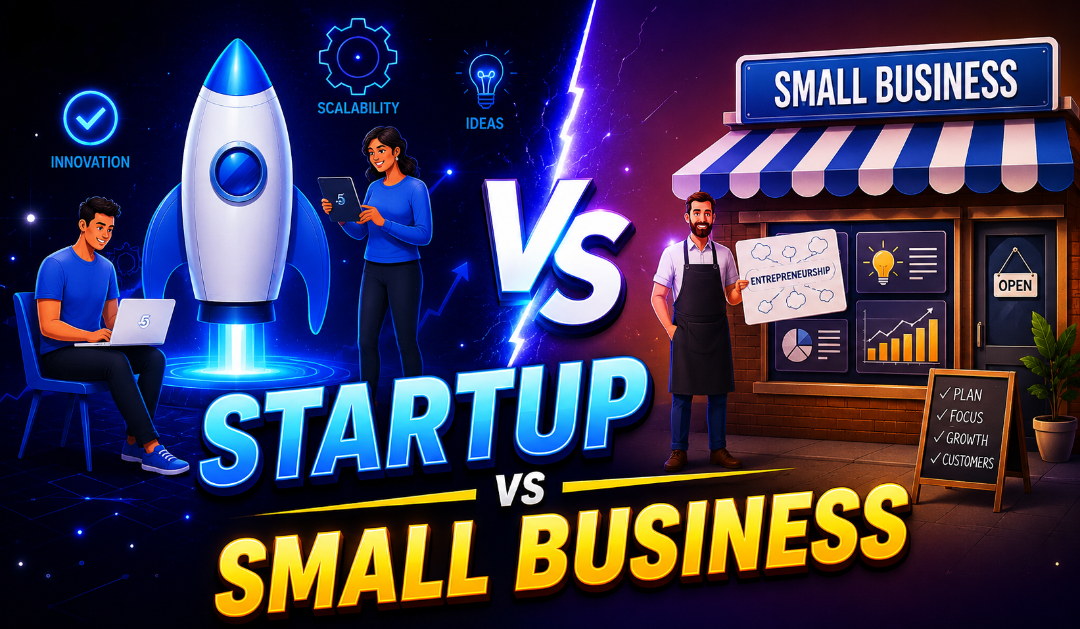
The confusion between a startup vs small business is one of the most common mistakes I see people make not just in how they describe themselves to others, but in how they make decisions. The type of business you are building should define how you fund it, how you hire, how fast you try to grow, and what you consider “success.” When you get that wrong, things fall apart not because you failed, but because you were playing the wrong game by the wrong rules.
Over the years, I have been on both sides of this divide. I have run a small business, I have consulted for early-stage startups, and I have watched people confuse the two with some pretty painful consequences. In this article, I want to share everything I have personally learned about what actually separates a startup from a small business not what the business school textbooks say, but what I have observed in the real world.
What Is a Startup?
When I first started paying close attention to the startup world, I expected to find a simple definition. What I found instead was a mindset almost a religion.
A startup is not just a young company. A startup is a business specifically designed to grow fast, usually by solving a problem in a way that has never been done before or by entering a market with a product that can scale to millions of users without a proportional increase in cost. The moment I sat in on my first seed-stage pitch meeting, I understood what separated these founders from everyone else: they were not thinking about next month’s revenue they were thinking about owning a category.
From everything I have seen personally, a startup has a few non-negotiable traits. First, there is an obsession with scale. A startup founder does not want ten customers they want ten million. Second, the business model is almost always unproven at the start. The whole point is to experiment, iterate, and find product-market fit before the money runs out. Third, startups typically rely on outside funding venture capital, angel investors, or accelerator programs because they are spending aggressively before they are earning meaningfully.
When I look at the startup vs small business debate through this lens, the distinction becomes very clear very fast. A startup is essentially a high-risk, high-reward experiment. The founder is betting that their idea can become something massive and they are willing to lose everything in the process of finding out.
What Is a Small Business?
I grew up watching my uncle run a small printing business. He had six employees, a loyal client base, and he took Sundays off. He was proud of what he built, and he should have been. But he never once talked about “disrupting” the printing industry or raising a Series A round. He just wanted to do good work, pay his people fairly, and build something that lasted.
That, to me, is the soul of a small business.
A small business is built for sustainability and profitability, not exponential growth. When I worked with small businesses early in my career a local restaurant, a family-owned logistics company, a boutique HR firm what I noticed was that the owners were deeply focused on their community, their cash flow, and their customers. The word “scale” came up occasionally, but it meant expanding to a second location, not capturing 30% of a global market.
The small business vs startup debate often gets framed as if small businesses are lesser somehow like they are startups that did not make it. I completely disagree with that framing. A small business is its own distinct model with its own logic. Many of them are profitable from day one or within the first year, which is something most startups cannot claim. The goal is not to flip the business or go public it is to build something durable and personally meaningful.
If you are building a business where you plan to be deeply involved in day-to-day operations, where your growth will be steady rather than explosive, and where you are funding yourself through revenue rather than investor capital, you are building a small business. And there is nothing wrong with that.
Startup vs Small Business: The Core Difference in Mindset
Here is what nobody tells you clearly enough: the biggest difference between a startup and a small business is not the size, the revenue, or even the industry. It is the founder’s mindset specifically, how they think about risk, growth, and what they are ultimately building toward.
I have had this conversation dozens of times with founders and entrepreneurs. The ones building startups almost always have what I would describe as a “go big or go home” psychology. They are comfortable with ambiguity, They find uncertainty exciting rather than terrifying. They are thinking about exit strategies an acquisition, an IPO, a merger from the very beginning. One founder I worked with had already mapped out his Series B narrative before he had a single paying customer. That is not delusion; that is startup thinking.
Small business owners, in my experience, think very differently. They want control. They want to build something they own fully, something that serves their family and their community. When I was helping a client build out her wedding photography business, she told me point-blank: “I never want to have investors. I never want to answer to anyone but my clients.” That sentence told me everything I needed to know. She was building a small business, and every piece of advice I gave her was filtered through that lens.
The startup vs small business difference in mindset also shows up in how each type of founder handles failure. Startup culture is almost romantically attached to failure “fail fast, learn faster” is practically a motto. Small business owners, on the other hand, cannot afford to treat failure as a learning experiment. When my uncle’s printing business had a bad quarter, it was not a pivot opportunity it was a crisis that affected six families. That is a very different relationship with risk.
Startup vs Small Business: A Side-by-Side Comparison
Before I go deeper into the individual differences, I find it helpful to see everything laid out clearly. This table is based on patterns I have personally observed over years of working with both kinds of businesses.
| Factor | Startup | Small Business |
| Primary Goal | Rapid scale, market dominance | Steady profit, long-term sustainability |
| Funding Source | VC, angel investors, accelerators | Self-funded, bank loans, personal savings |
| Risk Level | Very high most fail within 3 years | Moderate many survive with proper planning |
| Growth Speed | Exponential target (10x, 100x) | Gradual and sustainable (10–20% per year) |
| Revenue Focus | Often deprioritized early | Priority from day one |
| Team Structure | Small, fast-hiring, equity-driven | Lean, stable, salary-driven |
| Exit Strategy | Acquisition, IPO, or merger | Long-term ownership, often family succession |
| Innovation Role | Core to the entire model | Helpful but not essential |
| Founder Involvement | High initially, then delegates fast | High and often permanent |
| Customer Base | Mass market or global niche | Local or regional, often relationship-based |
When I show this table to people who are at the “what am I building?” stage of their journey, I often watch something click for them. The two models are not just different in degree they are different in kind.
Funding: Where the Roads Really Diverge
If there is one area where the startup vs small business difference becomes impossible to ignore, it is funding. And I say that from personal experience, because I have tried both routes.
When I was building my first venture, I went through a short-lived attempt to raise angel funding. I pitched to three investors, got politely rejected by all of them, and eventually bootstrapped the business to profitability on my own. Looking back, that rejection was a gift because what I was building was never a startup. It was a small business, and I was trying to fund it like a startup, which created a mismatch in expectations on every side.
Startups live and die by their ability to raise capital. From pre-seed to seed to Series A, B, and C, the funding journey of a startup is its own narrative arc. Founders spend enormous amounts of time sometimes more time than they spend building their product pitching to investors, managing cap tables, and planning their next fundraise. I have watched talented founders burn out not from building, but from fundraising. It is relentless.
The startup vs small business difference in funding philosophy is also the reason why the two types of businesses tolerate losses so differently. A startup can operate at a significant loss for years, as long as investors believe in the growth story. Small businesses, on the other hand, need to generate cash. When I was advising a small retail business a few years ago, the owner told me something I have never forgotten: “If I am not making money this month, I cannot make payroll.” That is a fundamentally different operating reality.
Small businesses typically fund themselves through personal savings, bank loans, SBA loans, or revenue from the business itself. There is no pitch deck. There is no investor dinner. There is a spreadsheet, a bank balance, and a lot of personal accountability. I actually find this model more honest in many ways you are directly accountable to reality rather than to a narrative you are selling.
Risk, Failure and What Nobody Tells You
I want to be honest with you about something: both models carry real risk. But the nature of that risk is very different, and understanding that difference could save you a lot of pain.
In the startup world, failure is statistically normal. From everything I have read and seen personally, somewhere between 80 and 90 percent of venture-backed startups either fail outright or never return meaningful capital to investors. The entire startup ecosystem is designed around this reality investors diversify across many bets, knowing most will not pay off. For the individual founder, though, a startup failure can mean years of lost salary, damaged relationships, and serious emotional fallout. I have seen it happen to people I respect enormously.
Small businesses fail too, of course but the failure curve looks different. In my observation, small businesses that survive their first two years have a reasonably strong chance of long-term survival, especially if they stay financially disciplined. The risks are more manageable because the bets are smaller. You are not raising $5 million and promising 10x returns. You are building a business that needs to cover costs and generate a living wage.
What nobody told me when I was starting out is that the psychological weight of these two models is completely different. Running a startup with investor money means you are accountable to other people’s capital. I have spoken to startup founders who could not sleep at night knowing that their friends’ and family members’ savings were tied up in their company. Running a small business means you are accountable to your own sustainability which is stressful in a different, more personal way.
Neither is easier. They are just different kinds of hard.
Growth Goals and Scaling: Not Everyone Wants to Be the Next Amazon
One of the most liberating realizations I have ever had in business is this: you do not have to want to build a billion-dollar company. That sounds obvious, but the culture around entrepreneurship especially in media, podcasts, and social media makes it feel like scale is the only worthy goal.
I disagree completely, and my personal experience backs me up.
I have worked with a small business owner who ran a specialty tea shop in a mid-sized city. She had one location, eight employees, and a deeply loyal customer base. Her revenue was consistent, her margins were healthy, and she loved going to work every day. By every meaningful measure, she had built a successful business. But she had been told so many times by well-meaning friends that she should “franchise it” or “take it online” that she had started to doubt herself.
This is exactly where the startup vs small business difference becomes a mindset issue with real consequences. Growth for the sake of growth is not a strategy it is a trap. A startup is explicitly designed to scale, and the investor expectations that come with startup funding make scaling non-optional. A small business can choose its own pace.
When I think about scaling, I always ask: what does success actually look like for this specific person? For a startup founder, success might mean an acquisition by a major tech company at a 50x multiple. For a small business owner, success might mean being able to hand a thriving business to their children. Both are legitimate. Both are real. But if you conflate them, you will spend your life optimizing for someone else’s definition of winning.
Team, Culture and Hiring Differences
The way startups and small businesses build their teams is so different that I sometimes think it is a culture shock when someone moves from one world to the other. I have seen it firsthand a friend of mine spent six years at a startup before joining his family’s manufacturing business, and he told me it felt like moving to a different country.
In the startup world, hiring is aggressive and equity-driven. When I was consulting for an early-stage SaaS startup, the founder was offering meaningful equity stakes to attract senior talent he could not afford to pay market salaries. The culture was flat, fast, and intense. People worked long hours because they believed in the mission and because they had skin in the game. There was an energy to it that I found genuinely exciting but also exhausting.
Small business hiring is a completely different animal. In my experience, small businesses hire slowly and carefully. They value reliability and loyalty over raw ambition. The people who work for small businesses often stay for years, sometimes decades. I once visited a small manufacturing company where several employees had been there for over twenty years. That level of retention is almost unheard of in the startup world but in a small business, it is a sign of health.
The culture in a small business tends to be more personal. The owner usually knows every employee by name, knows their family situations, and makes decisions with that context in mind. I find that kind of closeness genuinely valuable. It creates accountability and loyalty that no equity package can replicate.
Which One Should YOU Build?
This is the question I get asked more than any other, and I want to give you the honest, experience-based answer rather than a diplomatic non-answer.
Over the years, I have developed a simple set of questions I ask anyone who is trying to figure out which path is right for them. These are not questions from a business school textbook they are questions I wish someone had asked me earlier.
The first question I ask is: do you want to own something for the long term, or do you want to build something to sell? If your vision involves running this business personally for the next twenty years and eventually passing it on, you are thinking like a small business owner. If your vision involves building fast, capturing market share, and eventually being acquired or going public, you are thinking like a startup founder.
The second question is: how do you personally feel about other people’s money? If the idea of having investors people who have a claim on your decisions and your upside makes you uncomfortable, a small business funded through revenue and loans will suit you better. If you are comfortable with accountability to investors and excited by the resources that outside funding can provide, the startup path might be right for you.
The third question is: what is your genuine risk tolerance? Not the risk tolerance you think you should have, or the one that sounds impressive at a networking event your actual, honest appetite for losing everything and starting over. Startups require you to be genuinely comfortable with that possibility.
The fourth question I always ask is: do you have an idea that is genuinely scalable to a mass market, or are you building something that serves a specific, defined community? Not every great idea is a startup idea. Some of the best businesses I have ever seen were small businesses that deeply served a niche and they were more profitable and more fulfilling than many of the startups I have encountered.
My honest recommendation: most people should build a small business. Not because startups are not worth pursuing, but because most people when they strip away the cultural pressure to “think big” actually want what a small business offers: independence, stability, and something they can call their own.
Can a Small Business Become a Startup (and Vice Versa)?
This is one of my favorite questions because the answer is yes and I have seen it go both ways.
I know a founder who started a small catering business twelve years ago. It was local, profitable, and personal. Then she built a proprietary software tool to manage her logistics, realized the tool was more valuable than the catering business, spun it off, raised seed funding, and pivoted into a full-scale startup. Her small business became a startup almost by accident, because the idea she discovered inside it had genuine scale potential.
I have also seen the reverse. A startup that burned through its funding, could not find product-market fit at scale, but discovered a small, loyal customer segment that was genuinely profitable. Instead of folding, the founder returned the remaining capital to investors, downsized the team, and rebuilt as a sustainable small business serving that niche. He told me it was the best decision he ever made.
The lesson I take from both stories is that the labels matter less than the clarity. What matters is that you know which model you are operating in at any given moment because the decisions you make about funding, hiring, growth, and risk all flow from that fundamental choice.
Conclusion
When I look back at that co-working space moment being asked about my lead investor and having no answer I do not cringe anymore. I actually feel grateful. It forced me to get honest about what I was building and why.
The startup vs small business debate is not about which path is better. It is about which path is right for you, your goals, your risk tolerance, and the kind of life you want to build around your work. I have deep respect for both models, I have seen startups change industries and create extraordinary wealth, I have also seen small businesses sustain families for generations and make deep contributions to their communities.
What I cannot respect is the confusion the small business founder who is trying to run like a startup and burning out, or the startup founder who is secretly just building a lifestyle business and misleading investors in the process. Clarity is the foundation of everything.
Know what you are building. Build it with intention. And stop calling your catering company a startup just because it sounds cooler.
Frequently Asked Questions
What is the main difference between a startup and a small business?
The core difference lies in the intention behind the business. A startup is designed for rapid, exponential growth usually fueled by outside investment with the goal of capturing a large market or achieving a major exit like an acquisition or IPO. A small business is built for sustainable profitability and long-term ownership, usually funded by the owner and focused on serving a specific local or niche market.
Can a small business be called a startup?
Technically, any new business is “starting up,” but in the modern business world, the word startup carries specific meaning it implies a scalable model, investor funding, and aggressive growth targets. Using the term for a traditional small business can create confusion and misaligned expectations, especially when seeking funding or partnerships.
Which is more profitable a startup or a small business?
Small businesses are typically profitable much sooner than startups. Many startups operate at a loss for years while chasing growth, whereas a well-run small business can be profitable within its first year. However, a successful startup exit can generate wealth that dwarfs what most small businesses produce over a lifetime. The comparison depends entirely on what you mean by “profitable” and over what time horizon.
Do startups pay more than small businesses?
Startups often pay lower base salaries than established companies but compensate with equity, which can be extremely valuable if the company succeeds. Small businesses typically offer steady salaries without equity upside. In my experience, the total compensation comparison depends heavily on outcomes most startup equity never becomes valuable, while small business salaries are reliable.
Also Read About :- I Tested 10 ChatGPT Alternatives Free — Here’s What Actually Works in 2026