There’s a conversation I keep having with early-stage founders, freelancers, and people launching their first product. It goes something like this: they’ve got an idea, they’re excited, they’ve maybe even built a prototype and then someone asks them, “So is this B2B or B2C?” And they stare back with a look that tells me they’ve never really sat down and thought hard about that question.
I was that person once. Early in my career, I didn’t think the distinction mattered much. A customer is a customer, right? You build something good, you sell it, people buy it. That thinking cost me time, money, and more than a few sleepless nights trying to figure out why a strategy that worked brilliantly in one context completely fell apart in another.
After years of working across both models building products, running marketing, sitting in sales calls, and watching businesses scale and stumble I’ve developed a deep respect for just how different B2B vs B2C really is. Not just on paper, but in the actual day-to-day experience of running a business.
This article is everything I wish someone had told me before I learned these lessons the hard way. It’s not a textbook comparison. It’s a genuine breakdown from someone who has lived inside both worlds.
Why I Started Thinking Deeply About B2B vs B2C
The moment this distinction became real for me wasn’t in a business school classroom or a marketing seminar. It was a Tuesday afternoon when I was trying to figure out why a product I’d launched three months earlier wasn’t converting the way I expected.
I had built a tool for small businesses a simple invoicing and payment tracking solution. The product was solid. The feedback from the people who used it was genuinely positive. But sales were slow, the sales cycle felt endless, and I was burning through my runway faster than I had planned.
I was marketing it like a consumer product. I was running Instagram ads. I was focused on making the landing page emotionally compelling. I was A/B testing button colours. None of it moved the needle in any meaningful way.
A mentor I was speaking to at the time asked me a simple question: “Who is actually making the decision to buy this?” I started answering, and halfway through my sentence I stopped. Because I realised that the person seeing my Instagram ad wasn’t the person who had the authority or the budget approval to actually buy the product. I was marketing to the end user but ignoring the buyer. In B2B, those two people are often completely different.
That was the moment I stopped treating B2B vs B2C as a theoretical category and started treating it as the most operationally important question a business can ask itself.
–What Is B2B And Why the Textbook Definition Misses the Point
Most definitions of what is B2B will tell you it stands for “business to business” meaning a company sells its products or services to other companies rather than to individual consumers. That’s accurate, but it’s about as useful as telling someone that cooking is “the application of heat to food.” Technically correct. Practically useless.
Here’s how I actually think about what is B2B in a way that’s operationally meaningful: B2B is any model where the person using your product and the person paying for your product are often not the same person, and where the buying decision involves multiple stakeholders, a formal evaluation process, and a longer time horizon than a consumer purchase.
That last part is what changes everything. In a B2B sale, you’re not just convincing one person. You’re convincing a procurement team, a CFO who controls the budget, a department head who cares about outcomes, and an end user who cares about day-to-day usability. Each of those people has different priorities. Each of them can say no at a different stage of the process. And your job is to make sure none of them have a reason to.
When I worked with a SaaS company selling project management software to mid-sized companies, our average sales cycle was between six and nine weeks. That included a discovery call, a demo, a free trial period, a proposal, internal review at the client’s end, contract negotiation, and finally onboarding. Six to nine weeks for a product that cost around $300 a month. That’s the reality of B2B. The relationship has to be built before the contract is signed, and the value has to be proven before the cheque is written.
The other thing I’ve noticed about B2B that the textbook misses is that trust is the actual product. You can have the best feature set in the world, but if a business doesn’t trust you to deliver, to support them, and to still be around in two years, they won’t buy. I’ve seen technically inferior products win B2B deals simply because the team behind them inspired more confidence.
What Is B2C And What People Get Wrong About It
B2C business to consumer is on the surface the simpler model. You sell directly to an individual person. They see your product, they want it, they buy it. No committees, no procurement, no six-week sales cycles.
But here’s what I’ve learned from working on B2C products: simpler structure does not mean easier execution. In fact, I’d argue that truly excellent B2C marketing is one of the hardest things to get right in business.
The reason is that B2C buying decisions are almost always emotional before they’re rational. The consumer doesn’t sit down with a spreadsheet and evaluate your product against eight competitors across fourteen criteria. They feel something when they encounter your brand, your product, or your content and that feeling either pulls them toward a purchase or it doesn’t. Your job is to engineer that feeling, which is considerably harder than presenting a logical business case.
I spent about 18 months working on the growth side of a direct-to-consumer wellness brand. We were selling subscription boxes a genuinely good product with real quality. But what I discovered was that the product quality wasn’t what drove conversions. What drove conversions was the story around the product, the community we built, the user-generated content from happy customers, and the sense of identity people felt when they bought into the brand. We weren’t selling a box of wellness products. We were selling a version of the life people wanted to live.
That’s B2C. And once I understood it that way, everything from our content strategy to our ad creative to our email sequences shifted to reflect it. The results changed significantly once we made that shift.
B2B vs B2C – The Core Differences I Noticed in Real Life
Let me lay out the differences I’ve observed across my own experience, and then I’ll walk through the ones that surprised me most.
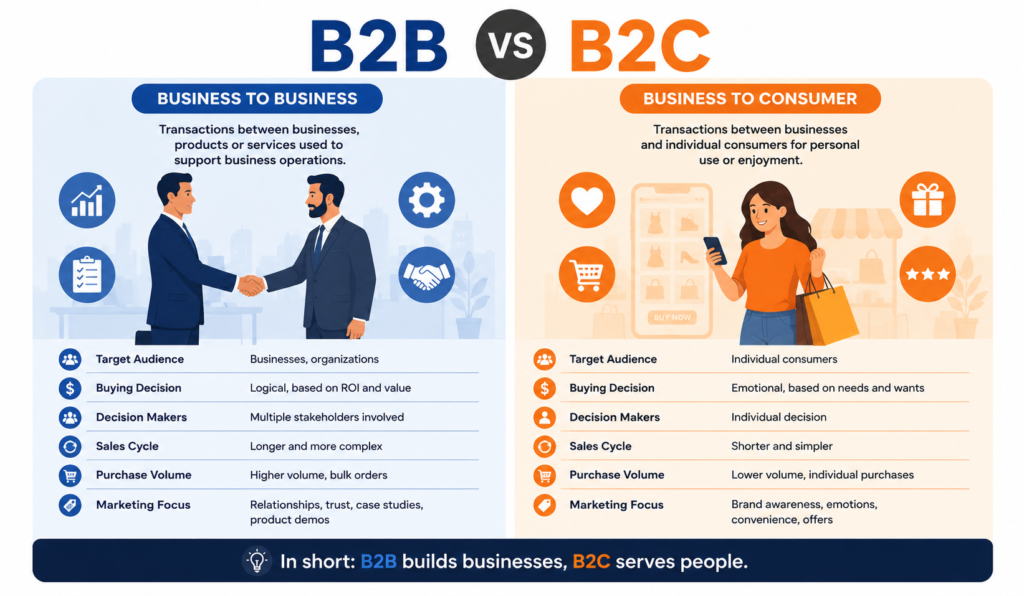
B2B vs B2C Side-by-Side Comparison
| Factor | B2B | B2C |
| Who is the buyer | A business, team, or department | An individual consumer |
| Decision-making time | Weeks to months | Minutes to days |
| Number of decision-makers | Multiple (often 3–7 stakeholders) | Usually one person |
| Relationship type | Long-term, contract-based | Often transactional |
| Average price point | High (hundreds to thousands per month) | Low to medium |
| Primary marketing channels | LinkedIn, email outreach, content marketing | Social media, SEO, paid ads, influencers |
| Sales cycle complexity | High demos, proposals, negotiations | Low click, checkout, done |
| Content that converts | Case studies, whitepapers, ROI calculators | Reviews, short videos, UGC, testimonials |
| Customer lifetime value | Very high | Variable depends on retention |
| Churn consequences | Losing one client = significant revenue loss | Losing one customer = minimal individual impact |
The row that surprises people most when I walk them through this table is the number of decision-makers. In my B2B experience, I have rarely encountered a deal where one person made the final call alone. Even in small companies with 10 or 15 employees, there’s usually a founder who needs to approve the budget, a team lead who needs to sign off on the workflow change, and often an IT person who needs to confirm it integrates with existing systems. Selling to all three of those people simultaneously, with different messages tailored to what each of them cares about, is a genuine skill and one that takes time to develop.
The churn consequence row is the other one I want to highlight. In B2C, losing a single subscriber or customer is a rounding error in your data. In B2B, losing a single client can mean a sudden 15 or 20% drop in monthly revenue. That asymmetry shapes everything how you prioritise customer success, how you handle complaints, how much you invest in account management. In B2B, every customer relationship deserves white-glove attention because the cost of losing it is so high.
The Sales Cycle Difference Where I Felt It Most
If you’ve only ever sold B2C, the B2B sales cycle will feel like moving through concrete. If you’ve only ever done B2B, the speed of a B2C conversion will feel almost magical.
I remember the first time I closed a significant B2B deal. It took eleven weeks from first contact to signed contract. Eleven weeks of follow-up emails, two demo calls, one on-site visit, a trial period, a proposal revision, and a final negotiation on terms. I had built what felt like a genuine relationship with the main contact by the end of it. We knew each other’s work situations, had discussed industry challenges at length, and had developed a level of mutual respect that went well beyond the transactional.
Compare that to the B2C side. I’ve run campaigns where we’d launch at 9am and have our first 200 sales by noon. The customer saw an ad, clicked through, read the landing page for 45 seconds, and bought. The relationship between me and that customer, at least at that initial moment, was essentially zero. The product and the brand did the work.
Neither of those experiences is better than the other they’re just completely different games. The B2B sale required patience, relationship management, and the ability to navigate an organisation’s internal politics. The B2C sale required compelling creative, a frictionless checkout experience, and a trustworthy brand presence. Trying to apply the skills of one to the other is where I’ve seen the most expensive mistakes happen.
Marketing Strategy How I Changed My Approach for Each Model
My marketing approach for B2B looks almost nothing like my marketing approach for B2C, and I learned that distinction the expensive way before I learned it the smart way.
For B2B, the channels and content that have consistently worked for me are: LinkedIn for organic reach and outbound prospecting, cold email sequences that lead with genuine value rather than a pitch, long-form content (blog posts, guides, case studies) that demonstrates expertise, and webinars or live events that build credibility with a targeted audience. The throughline in all of that is education and trust-building over time. B2B buyers don’t convert from a single touchpoint. They need to encounter your brand, your thinking, and your results repeatedly before they feel confident enough to start a conversation.
The biggest mistake I made early on was writing B2B blog content the way I’d write B2C content short, punchy, optimised for quick consumption. B2B buyers aren’t scrolling for entertainment. They’re looking for solutions to expensive problems. They want depth. They want evidence. They want to feel like the person or company they’re considering actually understands their world. A 300-word article doesn’t accomplish that. A 2,500-word deep dive with real examples and data does.
For B2C, the playbook is almost inverted. Short-form content wins. Emotional hooks win. Social proof particularly user-generated content from real customers wins above almost everything else. Paid social advertising on platforms like Instagram, Facebook, and increasingly TikTok has been where I’ve seen the best returns for B2C brands at the growth stage. The key is speed and repetition: get in front of the right person, create an emotional connection quickly, and make the path to purchase as short and frictionless as possible.
The biggest B2C mistake I’ve made and I’ve watched others make it too is leading with features rather than feelings. Consumers don’t buy features. They buy the version of themselves they’ll become after using the product. Every piece of content, every ad, every email in a B2C context should be answering the question: “How does this make the customer’s life better, and how does that make them feel?”
How to Classify Your Startup – SaaS vs B2B vs B2C
This is the question I get asked most often by early-stage founders, and it’s also the question that answering correctly before you build, before you hire, before you market can save you from months of wasted effort.
The challenge is that many modern startups don’t fit cleanly into a single box, especially SaaS products. A software tool can be B2B, B2C, or sometimes both simultaneously. Understanding how to classify startup SaaS vs B2B vs B2C requires you to ask a specific set of questions rather than just looking at what your product does.
How to Classify Your Startup: SaaS vs B2B vs B2C
| Model | Who Pays | How They Pay | Sales Motion | Example |
| B2B SaaS | Businesses / Teams | Monthly or annual subscription | Outbound, demos, trials | Salesforce, HubSpot, Notion (Teams) |
| B2C SaaS | Individual consumers | Freemium or low monthly fee | Inbound, paid ads, virality | Spotify, Duolingo, Canva (free tier) |
| Traditional B2B | Businesses | Invoice, contract, retainer | Relationship-driven, enterprise sales | Consulting firms, logistics providers |
| Traditional B2C | Individual consumers | One-time or repeat purchase | Retail, D2C, ecommerce | Clothing brands, FMCG, food delivery |
| B2B2C | Businesses who serve consumers | Subscription + usage fees | Mix of B2B sales + B2C growth | Stripe, Twilio, Shopify |
The three questions I personally use to classify any startup idea or product are:
The first question I ask is: who holds the budget? Not who uses the product who controls the money that pays for it. If the answer is a department head, a CFO, or a business owner making a business decision, that’s B2B. If the answer is an individual spending their own personal income, that’s B2C.
The second question is: how long does it take to convert someone from awareness to payment? If the realistic answer is days to weeks, you’re likely in B2C or prosumer territory. If the realistic answer is weeks to months, you’re in B2B territory and you need to build your team, your content, and your cash flow projections accordingly.
The third question and this is the one most founders skip is: what happens if I lose one customer? If losing a single customer is a minor data point in your analytics, you’re in B2C. If losing a single customer would materially hurt your monthly revenue, you’re in B2B, and your entire customer success infrastructure needs to reflect that reality.
Understanding how to classify startup SaaS vs B2B vs B2C before you start building means your go-to-market strategy, your pricing model, your content approach, your hiring plan, and your funding requirements can all be calibrated correctly from day one. Getting this wrong as I did early on means rebuilding all of those things halfway through, which is far more expensive than getting it right upfront.
When the Lines Blur – B2B2C and Hybrid Models I’ve Encountered
One of the things that makes this topic genuinely complicated in practice is that the cleanest examples of pure B2B or pure B2C are increasingly rare. The model I’ve encountered more and more frequently especially in tech and SaaS is something in between, often called B2B2C.
B2B2C means that a business sells to another business, but the end product or service is ultimately consumed by that business’s customers. Think of a payment processing company like Stripe: they sell to businesses (B2B), but the actual checkout experience is used by consumers (the B in B2C). Or think of a white-label software provider who builds the product, sells it to a business, and that business puts their own brand on it and sells it to their customers.
I worked with a startup in this space a customer engagement platform that sold to mid-sized retailers. The retailers paid the subscription (B2B sale), but the platform’s actual product was the experience their end customers had when interacting with the retailer’s loyalty programme (B2C experience). The interesting challenge was that we had to simultaneously satisfy two completely different sets of needs: the retailer needed ROI metrics, integration reliability, and account management support; the end consumer needed a seamless, enjoyable, emotionally rewarding experience.
If you find yourself in a hybrid model, my advice is to be very clear about who your primary customer is the one whose decision to stay or leave most directly impacts your revenue and build your core operations around serving them excellently. The secondary relationship matters, but conflating the two creates strategic confusion that’s hard to escape once you’re in it.
Pricing Psychology – Why It’s Completely Different in B2B vs B2C
Pricing is where I’ve made some of my most instructive and most expensive mistakes, and the root cause almost every time was applying B2C pricing logic to a B2B product or vice versa.
Here’s something that took me longer than it should have to internalise: in B2B, a higher price often increases perceived value rather than reducing it. When I was pricing a B2B analytics tool early in my career, I started with a monthly price I thought was “reasonable” something that felt approachable and wouldn’t scare anyone off. The sales conversations were strange. Prospects kept asking questions like “what’s the catch?” and “why is it so cheap compared to alternatives?” My low price was actually creating doubt about the product’s quality and the company’s longevity.
When I raised the price by a significant margin sales conversations improved. The prospects who engaged were more serious. The objections shifted from “this seems too cheap to be reliable” to genuine evaluations of ROI. And once they were calculating ROI rather than questioning legitimacy, closing deals became much more straightforward. B2B buyers are often spending company money rather than their own, which means the psychological friction around price is different. They want to feel like they’re buying something premium and dependable, not hunting for a bargain.
B2C pricing operates in almost exactly the opposite direction. Every additional dollar on your price tag is another opportunity for a consumer to abandon their cart. In B2C, I’ve consistently seen that pricing sweetspots exist at specific psychological thresholds $9.99 feels meaningfully different from $10, $29 feels accessible while $35 feels considered, and anything above $50 for an impulse-category purchase requires strong social proof and a compelling narrative to overcome. The science of B2C pricing is about removing friction and meeting people at the edge of what they’ll spend without thinking too hard.
Customer Retention The Metric That Looks Different in Each World
Both B2B and B2C businesses care deeply about retention, but the mechanisms that drive it and the consequences when it fails are dramatically different.
In B2C, retention is almost entirely about habit and emotional connection. The most successful B2C businesses I’ve encountered have built themselves into their customers’ daily or weekly routines so thoroughly that churning would feel like a disruption to the customer’s own lifestyle. Think about how Spotify works after three years of curated playlists, personalised recommendations, and Wrapped campaigns that make you feel seen, switching to a competitor isn’t just a practical decision, it’s an emotional one. That stickiness is intentional and deeply engineered.
My experience running retention for a B2C subscription product taught me that the window after the first purchase is the most critical period. In the first 30 days, I was trying to create a habit loop get the customer to use the product enough times, in the right contexts, that it became a natural part of their routine. If we got someone to week four with consistent engagement, our retention curve improved dramatically. If we lost them in week two, they almost never came back.
B2B retention looks nothing like that. In B2B, retention is primarily about relationships, outcomes, and the pain of switching. The relationship part means that your key contacts inside a client company need to feel supported, valued, and genuinely served by your team not just sold to and then ignored. The outcomes part means that your product needs to be demonstrably moving the needle on something the client cares about, and your customer success team needs to be proactively showing them that data. The switching cost part means that the more deeply integrated your product is in their workflow, their data, and their team’s habits, the higher the barrier to leaving.
I’ve seen B2B businesses survive with mediocre products simply because switching away from them was too painful for established clients. And I’ve seen excellent B2B products lose clients because no one was actively managing the relationship or communicating the value being delivered. In B2B, out of sight genuinely means out of contract at renewal time.
Which Model Is Right for You? My Honest Framework
After everything I’ve learned from my own mistakes, from the businesses I’ve worked with, and from watching founders make the same avoidable errors over and over here is the honest framework I use when someone asks me whether they should build a B2B or B2C business.
The first thing I consider is founder temperament. B2B requires patience, comfort with long sales cycles, an ability to build relationships over time, and a tolerance for high-stakes individual deals. B2C rewards speed, creative instinct, data obsession at scale, and the ability to build brand resonance with a mass audience. Neither is objectively better but one of them probably describes you better than the other. Self-awareness here is underrated.
The second thing I look at is capital efficiency. B2B businesses, particularly SaaS ones, tend to have higher customer lifetime values, lower volume requirements to reach profitability, and more predictable revenue once the contracts are signed. If you’re bootstrapping or working with limited runway, B2B is often the more capital-efficient path to early sustainability. B2C businesses, particularly consumer apps or D2C brands, often require significant upfront investment in brand building and paid acquisition before the unit economics start to work.
The third thing I weigh is the problem being solved. Some problems are inherently individual and personal which points toward B2C. Others are structural business problems that exist at an organisational level which points toward B2B. The best businesses I’ve seen are ones where the model choice was obvious because the problem itself made it obvious. If you’re agonising over which model to choose for a given idea, it might be worth asking whether the idea itself needs rethinking.
My general recommendation for first-time founders, based on what I’ve observed: start with B2B if you can. The feedback loops are more direct (you’re talking to real decision-makers), the revenue per customer is higher (which means you need fewer customers to learn and survive), and the relationships you build create network effects that compound over time. B2C can be enormously rewarding and scalable, but it tends to require either significant capital or exceptional brand intuition and often both. Get your first wins in B2B, learn the fundamentals of building something people pay for, and then decide if B2C is where you want to go.
Frequently Asked Questions
What is B2B in simple terms?
B2B business to business means a company sells its products or services to other companies rather than to individual consumers. In my experience, the most important thing to understand about what is B2B isn’t the label itself, but what it implies: multiple decision-makers, longer sales cycles, higher contract values, and a relationship-driven approach to both selling and retention.
Is SaaS always B2B?
No, and this is one of the most common misconceptions I encounter. SaaS simply means software delivered as a subscription over the internet the model says nothing about who the customer is. Spotify is SaaS and it’s B2C. Salesforce is SaaS and it’s B2B. Canva has both a B2C free tier and a B2B Teams product. When evaluating a SaaS product, you still need to apply the same classification questions: who holds the budget, how long is the decision cycle, and what happens when you lose one customer.
Can a business be both B2B and B2C?
Yes, absolutely and more businesses are moving in this direction. I’ve worked with several companies that serve both audiences, sometimes with separate product tiers and sometimes with a unified platform. The challenge is that your marketing, sales, pricing, and customer success approaches need to be fundamentally different for each audience. Companies that try to serve both with a single unified strategy usually end up serving neither well.
Which is more profitable B2B or B2C?
This depends entirely on execution, market size, and business model specifics. B2B businesses tend to have higher margins per customer and more predictable revenue. B2C businesses can achieve enormous scale when they work, which translates to high total profitability even with lower margins per customer. From my personal observation, B2B SaaS businesses tend to have the most favourable unit economics at the early and mid stages, while the largest B2C consumer businesses eventually dwarf them on absolute revenue.
What are examples of B2B and B2C companies?
Classic B2B examples include Salesforce (CRM software for businesses), McKinsey (consulting for corporations), and Mailchimp when used by companies to manage their marketing. Classic B2C examples include Amazon (retail to consumers), Netflix (entertainment subscriptions), and Nike (footwear and apparel sold directly to individuals). Examples of companies operating in both spaces include Microsoft (sells Office to businesses and consumers), Apple (sells devices to individuals and enterprise), and Zoom (which has both consumer and business plans).
Also Read About :- Startup vs Small Business